

FRANCHISE BUYER INSIGHTS
Two Types of Buyers. Two Different Sales Processes.
The franchise development industry spends $17,550* to acquire a single franchise sale — with a 1-2% lead-to-sale conversion rate. The biggest reason: treating every candidate the same. They're not.
Franchise Ninja identifies the difference and responds accordingly.
*Does not include staffing and brokers
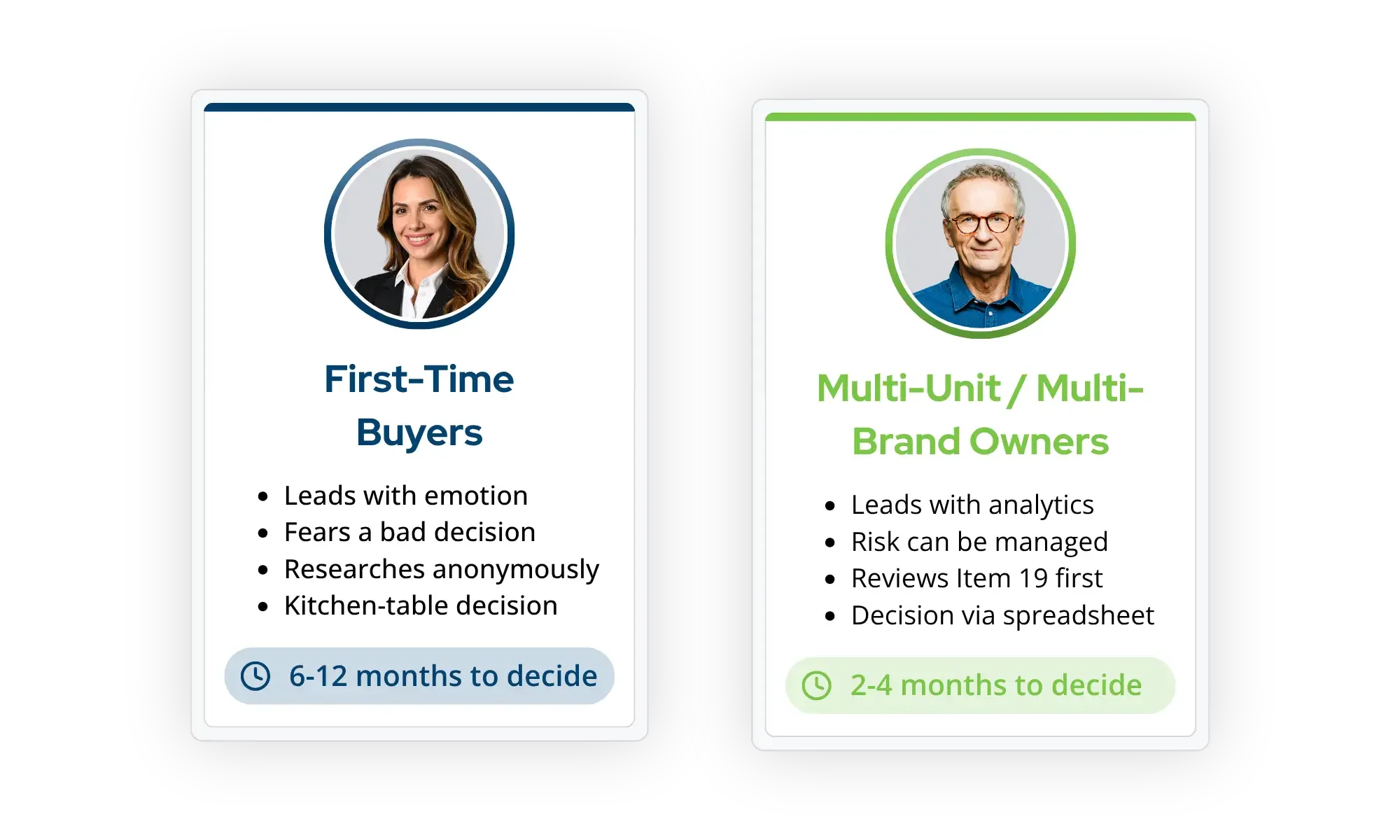
THE TWO FUNDAMENTAL BUCKETS
Every Franchise Buyer Falls Into One of Two Categories
Understanding this distinction — and acting on it — is the difference between a 2% close rate and a meaningful improvement on it.
Here's what separates them, and why it matters for your Fran Dev team.
First-Time Buyer
"I've been thinking about this for two years. I haven't told anyone. What if I'm making a huge mistake?"
- The #1 fear isn't failing — it's making a "stupid" decision. Fear of regret outweighs fear of loss.
- They research anonymously. They won't give real contact info until they feel safe.
- The employee becoming a business owner is a profound identity shift that triggers imposter syndrome.
- The real decision happens at the kitchen table with their spouse. Your team rarely talks to both.
- They emotionally attach to a brand before doing any financial analysis. Logic follows feeling.
- Googling: "best franchise opportunities," "is franchising worth it"
- Franchise portals and comparison sites — anonymously
- YouTube: day-in-the-life videos, "what I wish I knew before buying a franchise"
- Reddit: r/franchise, r/smallbusiness — looking for unfiltered opinions
- Facebook groups for aspiring entrepreneurs
- 70%+ of their research happens between 9pm and midnight — private and personal
- AI Discovery identifies them during late-night anonymous research — months before a form fill
- Ninja Score accounts for longer timelines and emotional readiness signals
- Education-first nurturing: validation content, franchisee stories, permission-giving messaging
- Spouse/partner acknowledged in nurturing content, not ignored
Multi-Unit Operator
"Send me Item 19, territory maps, and the development schedule. I can have a decision in 60 days."
- They've already crossed the psychological Rubicon of business ownership. The identity shift happened years ago.
- They evaluate risk through spreadsheets, not emotions. Risk is a variable to manage — not a reason to freeze.
- They don't need hand-holding. They've been pitched before. They know what marketing looks like vs. reality.
- The Item 19 isn't scary — it's the first page they analyze, and they know how to read between the lines.
- Multi-unit portfolios sell at 4.5–6× EBITDA vs. 2.5–3.5× for single units. They're already thinking about their exit multiple.
- FDD databases — reading Item 19 like a financial analyst
- Franchise attorney and CPA reviews from day one
- LinkedIn — researching existing franchisees and leadership
- Franchise conferences and development events — already in the network
- Directly comparing territory availability and development agreements across brands
- Their decision influencer: a franchise attorney or CPA on retainer — not a spouse
- Separate Ninja Score track tuned to multi-unit expansion signals and financial indicators
- Discovery identifies them through FDD research activity and portfolio comparison behavior
- Data-forward nurturing: unit economics, territory intelligence, development agreements
- Faster score escalation — these prospects are ready for human contact sooner
SIDE-BY-SIDE COMPARISON
Every Dimension of How They Buy Differently
From psychology to digital behavior to decision timeline — these two buyer profiles require fundamentally different approaches.
KNOW WHO YOU’RE REALLY TALKING TO
The Two Buckets Hold 15 Different Personas
Inside each profile — first-time buyer and multi-unit operator — are distinct personas with different motivations, financial profiles, and research patterns. A corporate refugee fleeing burnout needs a different message than a retiree building an encore career. A private equity buyer reading Item 19 at 8am operates nothing like the multi-brand mogul who already has six territories.
Franchise Ninja identifies which persona each prospect matches — automatically — and adjusts the Ninja Score weighting, nurturing content, and rep briefings accordingly. No manual tagging. No guesswork.
THE COST OF ONE-SIZE-FITS-ALL MESSAGING
One-Size-Fits-All Messaging is One of the Most Expensive Mistakes in Fran Dev
Most marketing leads never convert to sales — but the ones that do fail often don't fail because of bad leads. They fail because a fear-driven first-time buyer and a seasoned multi-unit operator got the exact same pitch. One goes quiet. The other goes cold. And your $351 CPL disappears with them.
You're Pushing When You Should Be Educating
A first-time buyer who gets urgency-pressure content before they're emotionally ready doesn't push back — they disappear. Silence isn't disinterest. It's overwhelm. And you'll never know which it was.
You're Educating When You Should Be Closing
A multi-unit operator who gets basic "what is a franchise?" content reads it as disrespect. They're running locations. They want Item 19, territory maps, and deal structure. Explaining franchising 101, signals you don't know who you're talking to.
You're Paying $351/Lead to Mishandle Them
At those CPL numbers, you cannot afford to use the same approach for two completely different buyers. Persona-based targeting and scoring isn't a nice-to-have. It's the math that's needed to win.
- Identified months before form fill — during late-night anonymous research
- Education-first nurturing: validation stories, "can I do this" content, spousal acknowledgment
- Ninja Score accounts for emotional readiness signals, not just click frequency
- Rep receives emotional profile brief before first contact — knows the fear, knows the driver
- Identified through FDD research activity and portfolio comparison behavior
- Data-forward nurturing: unit economics, territory intelligence, development agreements
- Separate Ninja Score track tuned to expansion signals and financial sophistication
- Faster escalation to human contact — these buyers decide in 60 days when treated right
The Data Behind the Differentiation
Ready to Stop Using the Same Approach for Two Different People?
Franchise Ninja identifies which type of buyer every prospect is — and triggers the right response automatically. No manual segmentation. No guesswork.