
Summary: The Veteran franchise buyer includes veterans, transitioning service members, military retirees, reservists, Guard members, and military spouse households. This profile covers their demographics, motivations, preferred franchise types, and decision timeline. It also covers the pain points they face and how to market to them.
This article continues our monthly series looking at the 15 franchise buyer personas. Each persona represents a distinct segment of candidates, defined by their backgrounds, motivations, decision-making styles, and investment concerns.
In this month’s article, we take a deep dive into the Veteran franchise buyer. This persona includes veterans, transitioning service members, military retirees, reservists, Guard members, and military spouse households who are evaluating franchise ownership.
Veterans bring a unique mix of leadership experience, operational discipline, service orientation, and risk awareness. They are often drawn to franchising because it offers a proven system, clear standards, training, and support. At the same time, they need strong proof that the opportunity is financially sound and operationally realistic.
Meet the Veteran Franchise Buyer
The Veteran franchise buyer is a mission-driven and structure-oriented candidate. They are looking for the next chapter that offers purpose, leadership, and control. Franchise ownership appeals to these individuals because it offers independence and business ownership without having to start from scratch.
Franchising, as a whole, also aligns with many skills developed during military service. Veteran candidates understand systems, standards, accountability, training, teamwork, and execution. VetFran describes franchising as a model that connects military experience with structured business ownership, training, operating standards, mentorship, and a network of fellow operators.
When speaking to Veterans pursuing franchising as a future, it’s important not to speak to them with shallow patriotic messaging. Vets respond better to credibility, transparency, and proof. They want to see how a brand supports owners, understand the investment, and know how long it may take to reach stability. They also want to hear from other veterans within your brand who have already made the transition.
For franchisors, this persona can be highly valuable. Veterans are already active in business ownership. In 2021, there were 1,621,823 majority veteran-owned firms in the United States. These businesses employed 3,251,345 workers and generated $983.9 billion in sales.
What is the Demographic Profile of the Veteran Franchise Buyer?
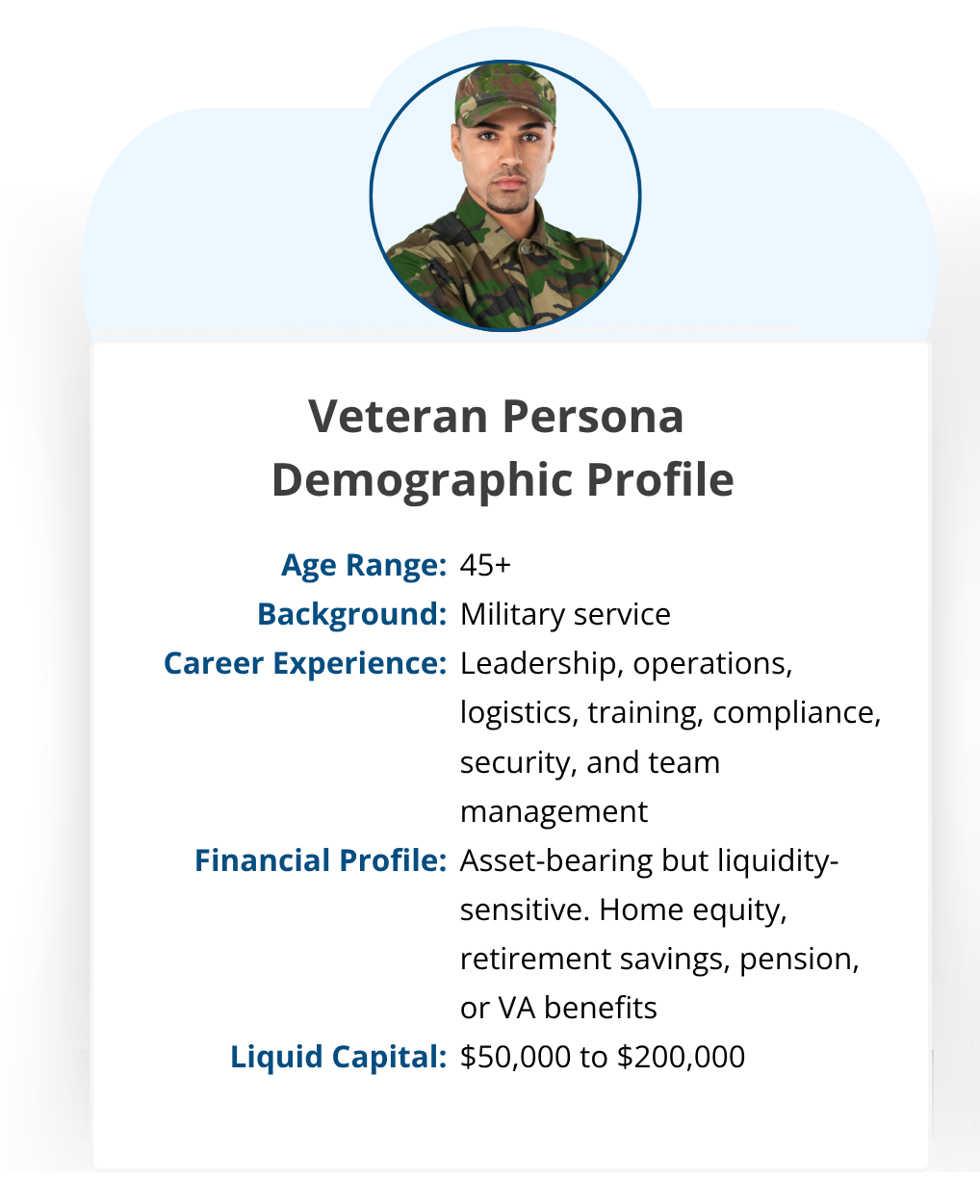
The Veteran franchise buyer persona includes a broad range of candidates. It can include a recently separated service member, a mid-career veteran in a civilian leadership role, a military retiree, or a later-career professional with military experience. It may also include a spouse-led household where the family is exploring franchise ownership together.
The highest-probability candidates skew older than some other first-time franchise buyer personas. SBA data states that veteran business owners are more likely to be over age 65. This makes later-career ownership, semi-retirement ownership, and legacy-building important themes.
The employment backdrop also matters. Many veteran candidates are not simply looking for replacement employment. The Bureau of Labor Statistics reported a 3.5% unemployment rate for veterans in 2025, compared with 4.2% for nonveterans. This suggests many prospects are evaluating ownership for control, purpose, income growth, or long-term financial independence.
Their professional background often includes leadership and operational roles. Common areas of experience may include:
Operations
Logistics
Maintenance
Training
Compliance
Project execution
Team management
Security
Government contracting
Public service
Corporate operations
Sales or business development
Their educational background can vary, with census data showing veteran business owners across several education levels, including high school or GED, some college, bachelor’s degrees, master’s degrees, and professional degrees. This means marketing should be clear and professional. But should also not assume every candidate has the same business education.
Financially, this persona can be asset-bearing, but liquidity-sensitive. Census SIPP data found veteran household median net worth of :
$109,500 for ages 45 to 54
$160,809 for ages 55 to 64
$272,949 for ages 65 to 74
This data is useful, but has limits as it includes home equity and excludes pension equity, so it does not directly show cash available for investment.
Many franchise opportunities require significant liquid capital. Franchise.com cites an International Franchise Association range stating that initial liquid capital for franchises often falls between $50,000 and $200,000. This range is especially important for Veteran candidates. They may have total household wealth, but that does not always translate into liquid funds they are comfortable investing.
What Motivates the Veteran Franchise Buyer to Buy a Franchise?
Motivation is central to understanding this persona. Veteran buyers are often looking for more than income. They are looking for a new mission, a leadership role, and a business path that gives them structure without limiting their independence.
Mission continuity is one of the strongest motivators for these individuals. Military service creates a strong identity around duty, team responsibility, discipline, and impact. Franchise ownership can become a new arena where Veterans can apply those values in a civilian setting.
Autonomy is another major driver for those who want more control over their work, income, schedule, and future, but do not want unstructured entrepreneurship. Many are drawn to franchising because it offers autonomy within a defined system.
Research on American military veteran entrepreneurs found that self-employed veterans showed higher levels of openness, optimism, achievement orientation, need for autonomy and professional development, community integration, and altruistic service compared with employed veterans. These traits match many of the reasons franchising can appeal to this group.
Franchising offers several advantages that align with these motivations. The most important advantages include:
A proven operating system
Clear standards and procedures
Training before launch
Ongoing support
Peer connection
A brand with existing market presence
A path to lead teams and serve a local market
Financial independence also matters. Veteran buyers may want to build income, equity, and long-term enterprise value. Some are looking for a business that can involve a spouse or family member. Others want an asset that can support retirement, community impact, or a legacy plan.
This persona also values a direct connection between effort and outcome. Franchise ownership provides the ability to apply discipline and leadership to a business model where local execution matters. That can be more appealing than returning to a role where advancement, culture, or compensation may be outside their control.
What Kind of Franchises Draw Veteran Franchise Buyers?
Veteran franchise buyers are often drawn to brands with structure, training, practical support, and clear operating expectations. They want to understand what must be done, how success is measured, and what support the franchisor provides after signing.
Strong brand fit often includes business models where execution, local leadership, team building, and reliability matter. These categories can be a natural match:
Home services
Skilled trades
Restoration
Cleaning and maintenance
Property services
Senior care
Business services
Staffing
Security
Logistics and transportation
Fitness, youth sports, and wellness
Select food or QSR concepts
Home services and skilled trades can be especially relevant because they often rely on scheduling, crews, customer service, quality control, and local reputation. These are areas where operational discipline and team leadership can matter.
Restoration, cleaning, maintenance, and property service brands can also be appealing. These categories often require clear processes, responsiveness, logistics, and accountability. Those requirements can fit candidates who are comfortable with standards and field execution.
Senior care and health-adjacent services may resonate with veterans who want a strong community impact. These concepts can connect with the service-oriented side of the persona. They can also appeal to later-career buyers who want meaningful work, not only income.
Business services, staffing, security, logistics, and transportation can fit veterans with corporate, technical, supply chain, personnel, or operational backgrounds. These sectors can allow the candidate to use leadership skills in a professional services or B2B setting.
Select food and QSR concepts may appeal because they offer strong systems and brand recognition. However, these models should be qualified carefully. Real estate, staffing, equipment, food costs, and capital requirements can raise the risk profile.
As with any prospect, the best franchise match depends on the candidate’s capital, desired role, physical involvement, family goals, and appetite for staffing complexity. A veteran buyer may be a strong owner-operator, a manager-led owner, a semi-absentee owner, or a multi-unit operator. The right fit should be based on evidence, not stereotypes.
How Quickly Do Veteran Franchise Buyers Commit?
Veteran franchise buyers often move through a disciplined evaluation process. They may be interested early, but they usually need proof before they commit.
The decision-to-sign portion may take 60 to 180 days. This depends on the candidate’s capital readiness, family involvement, financing needs, concept complexity, and confidence in the franchisor’s support system.
Several factors can extend the timeline:
Reviewing the Franchise Disclosure Document
Comparing multiple franchise concepts
Evaluating financing options
Speaking with current franchisees
Reviewing Item 19 information when available
Discussing the decision with a spouse or family member
Assessing the risk to retirement assets or savings
The full path from inquiry to opening can take longer. Public franchise timeline guidance often frames the full process as several months to more than a year, depending on site selection, financing, permitting, legal review, buildout, and training.
Home-based, mobile, and service-based models may move faster. Brick-and-mortar concepts can take longer because they often involve location search, lease negotiation, buildout, equipment, staffing, and permitting.
This deliberate timeline should not be viewed as hesitation alone. It reflects a careful decision style. Veteran candidates often want to understand the mission, the risks, the standards, and the support before they move forward.
What Pain Points Do Veteran Franchise Buyers Face?
Veteran franchise buyers face a unique set of concerns when they evaluate franchise ownership. The first concern is whether military experience truly translates into civilian business ownership. A candidate may have led teams, managed high-pressure situations, and executed complex operations. They may still question whether those strengths will translate into customer acquisition, local marketing, hiring, cash flow, and daily business management.
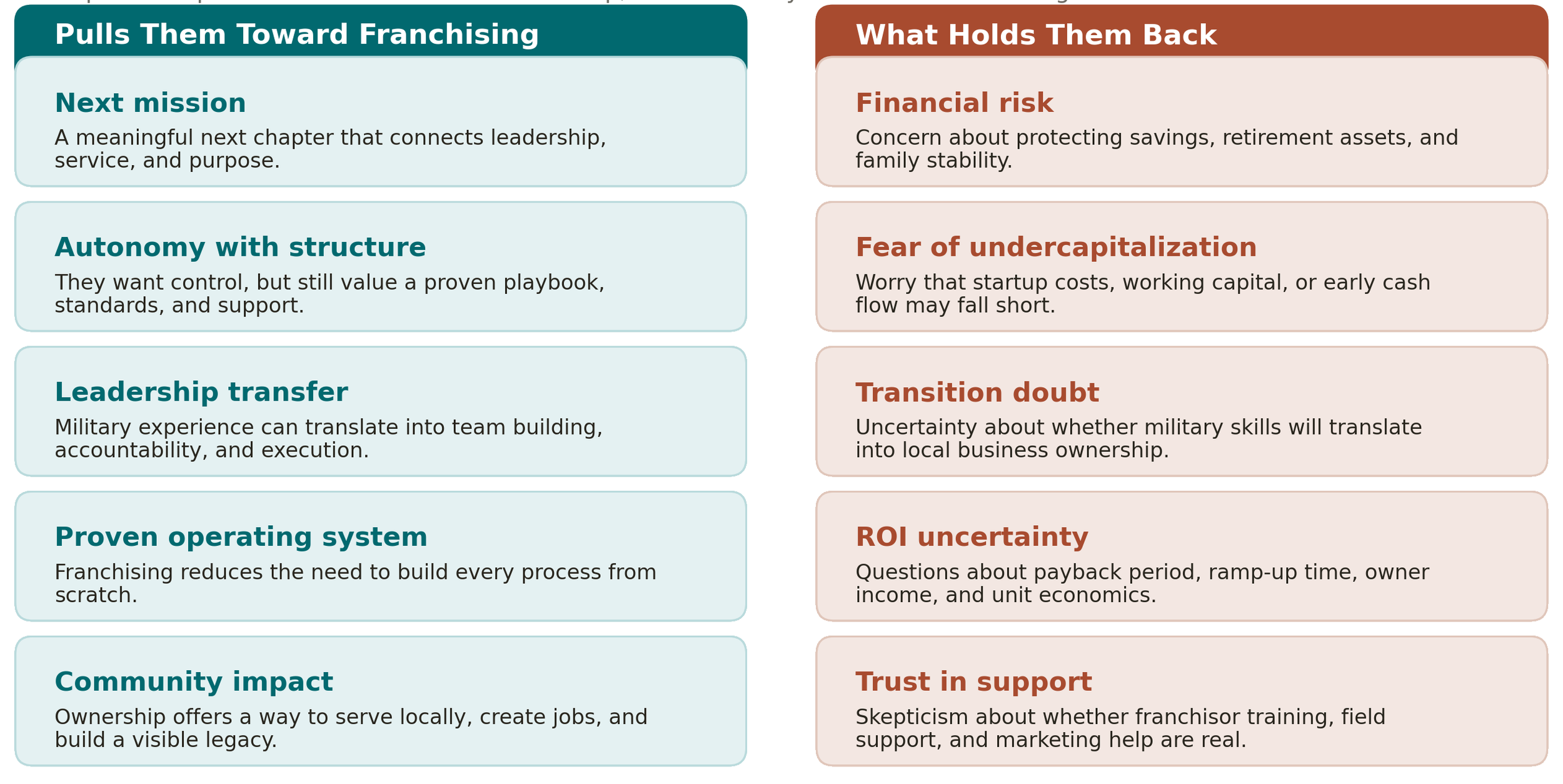
The second major concern is financial risk. Veteran-owned firms are more likely to experience challenges with credit availability. Majority veteran-owned businesses have also reported increased costs, operating expenses, uneven cash flow, weak sales, debt payments, and credit availability as financial challenges.
Access to capital can also be difficult. The Milken Institute reports that veterans and military spouses can face worse capital outcomes than non-veteran peers. These outcomes include lower approval rates, greater financing shortfalls, and disadvantages tied to personal credit history and small-dollar loan requests.
As with many other first-time franchise owners, the biggest financial concerns for Veterans include:
Unclear payback period
Insufficient liquid capital
Debt-service risk
Fear of undercapitalization
Uncertain ramp-up time
Weak confidence in financial performance data
Concern about protecting family income
Concern about using retirement assets or home equity
Limited clarity around royalties, fees, payroll, rent, vehicles, equipment, or inventory
Liquidity is often a bigger issue than total net worth. A candidate may have home equity, retirement savings, pension income, or other household assets. That does not mean they want to put those assets at risk. It also does not mean those assets are available as working capital.
Another pain point is trust. Veteran buyers may be skeptical of broad income claims or overly emotional sales messaging. They may want plain-language explanations, candid risk discussions, and realistic expectations.
The loss of familiar structure can also create hesitation. Franchising provides a system, but ownership still requires the candidate to carry responsibility for local sales, hiring, customer experience, and cash flow. That shift can feel significant, even for an experienced leader.
How to Market To and Attract the Veteran Franchise Buyer
Effective marketing to the Veteran franchise buyer should combine respect, clarity, and proof. The message should acknowledge their service and leadership. It should also show exactly how the franchise model supports their next step.
Content that resonates most often starts with identity and then moves quickly into evidence. Veteran franchisee stories are especially valuable. They help candidates see how military experience can translate into ownership. They also make the opportunity feel more credible.
Educational resources should help the candidate evaluate fit. Strong content topics include:
How military leadership translates into franchise ownership
How to compare franchise models by capital, role, and risk
What veterans should know before reviewing an FDD
How to estimate working capital and cash-flow runway
How veteran incentives and franchise-fee discounts may work
How SBA lending and financing readiness apply to franchise candidates
What questions to ask current franchisees during validation calls
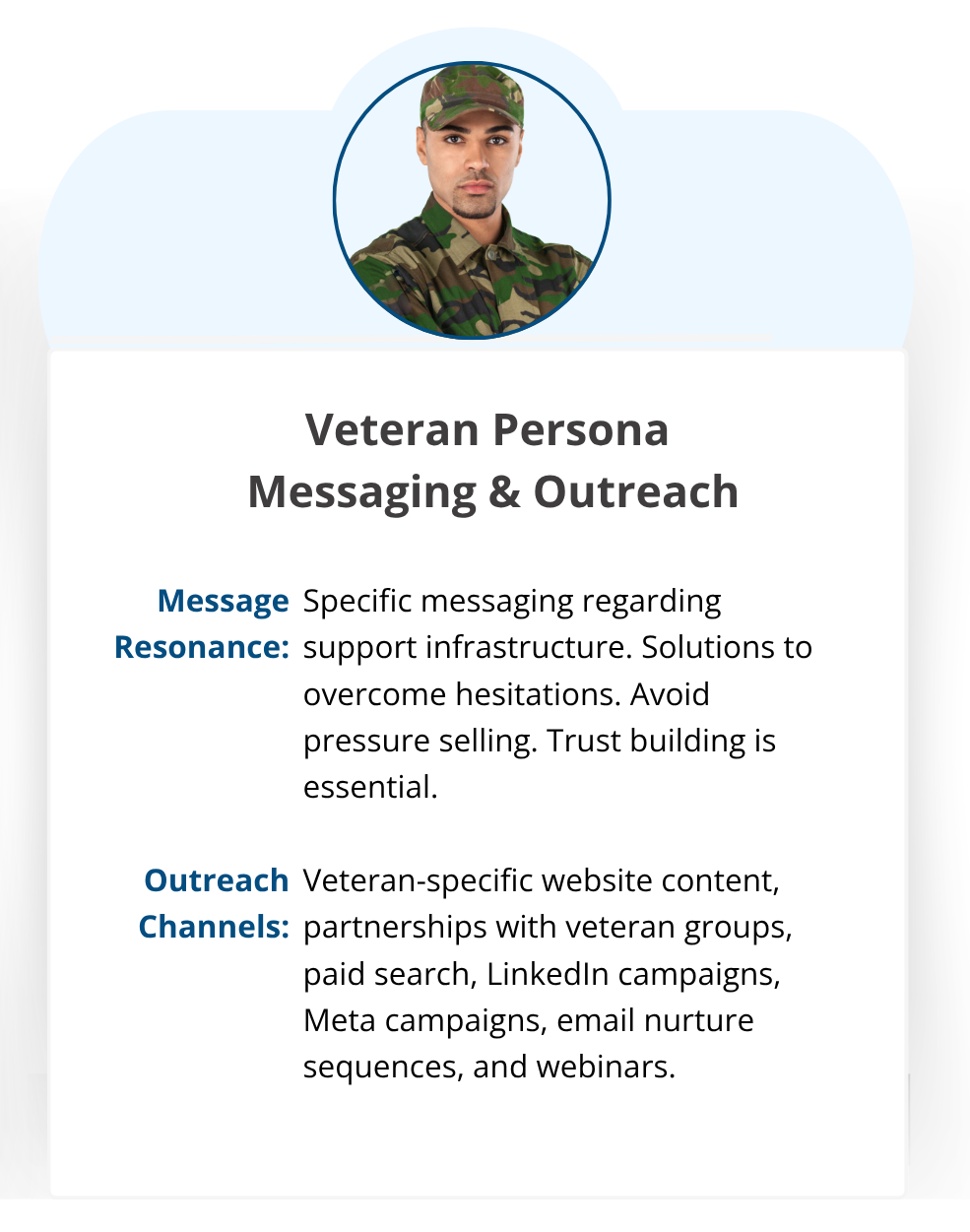
Messaging should emphasize the support infrastructure of the franchise system. This should be specific, not vague. Strong proof points include:
Initial training
Launch support
Field support
Standard operating procedures
Marketing support
KPI dashboards
Peer networks
Mentorship
Vendor relationships
Clear escalation paths
The strongest core message is simple: your next mission, backed by a proven system. This message works because it connects purpose with structure. It also avoids promising an easy path.
Marketing and outreach should be targeted across channels where veteran candidates may research ownership. Effective strategies include:
Veteran-specific SEO pages for high-intent searches
Paid search around veteran franchise opportunities
LinkedIn campaigns focused on leadership and operations experience
Meta campaigns where targeting rules allow compliant audience building
Retargeting based on visits to veteran, financing, and franchise education content
Email nurture sequences built around fit, capital, validation, and next steps
Webinars with veteran franchisees or franchise development leaders
Partnerships with veteran entrepreneurship groups, chambers, consultants, and transition resources
For this group, sales enablement matters as much as lead generation. Franchise development teams should be prepared to speak clearly about capital requirements, financing options, expected owner role, validation, support, and risk. They should also be ready to translate military experience into specific franchise ownership responsibilities.
Solutions to overcome hesitation should be practical. The most effective tools include:
A liquid capital readiness calculator
A working-capital runway worksheet
A veteran franchisee validation guide
A 90-day franchise evaluation plan
A spouse or family decision guide
A transparent investment summary
A plain-language FDD review checklist
A list of available veteran incentives
A realistic ramp-up discussion
Franchisors should avoid pressure-based selling with this persona. A structured evaluation process will often work better. The candidate should feel guided, not rushed.
Ultimately, successful brands build trust by combining inspiration with operational and financial clarity. Veteran buyers may be highly motivated, but they also need proof that the franchise is a responsible fit for their capital, family, leadership style, and long-term goals.
What’s Up Next?
The Veteran franchise buyer is a mission-driven, yet financially cautious individual. This candidate often brings leadership experience, operational discipline, and a strong desire for purposeful ownership. They may also bring valid concerns about capital, risk, support, and the transition into civilian business ownership.
By understanding these motivations and concerns, franchisors can create better marketing, stronger nurture paths, and more useful sales conversations. The most effective approach is not generic veteran messaging. It is a clear, respectful, proof-driven strategy that helps the candidate evaluate whether the franchise is the right next mission.
Upcoming articles in this franchise buyer persona series will continue to explore the motivations, concerns, and decision paths of other high-value franchise candidates. Each profile will help franchise brands build more targeted franchise development strategies and stronger relationships with the right future owners.
Check out the other franchise buyer personas in the series:
