
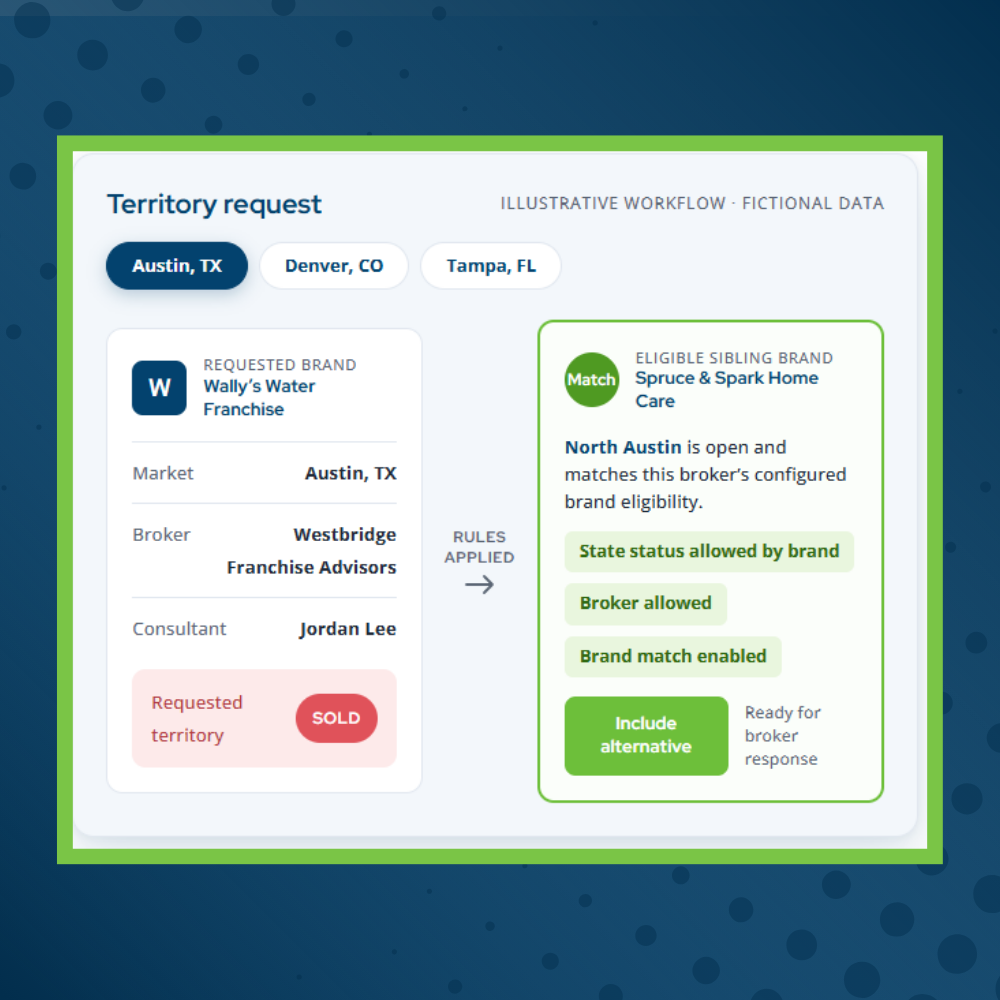
A broker asks whether Austin is open for one of your brands. It is not. Sold eighteen months ago.
In most portfolios the reply is one word, and the conversation is over. The broker goes back to the candidate with nothing, and that candidate becomes somebody else's franchisee.
Now consider what was actually true in that moment. You owned four brands. One of them had North Austin open. It matched the broker's agreement, the state was registered, and the concept was a reasonable fit for a candidate who had already raised their hand for that metro.
Nobody knew, because nobody had a way to know quickly enough to matter.
That is the single largest missed opportunity in platform brand territory checks, and it happens every week.
The Advantage Platform Brands Rarely Use
Owning multiple brands is supposed to mean more ways to say yes.
In practice, most platform brands answer territory checks brand by brand, in isolation. The person answering for Brand A knows Brand A's map. They do not have Brand B's availability, Brand B's registration status, or Brand B's broker agreements at hand. So the answer stops at the requested brand.
The portfolio exists on the org chart and in the marketing. It does not exist in the reply email.
Fixing that does not require a new sales motion. It requires the answer to know what else you own.
What Happens When a Franchise Territory is Already Sold?
When a requested territory is unavailable, an automated system can surface an eligible sibling brand with open capacity in that market, or an alternate territory nearby that fits the request. Every suggestion follows the brand matching, broker eligibility, state status, and visibility rules the franchisor configures in advance.
The key phrase is "configured in advance." This only works if the rules are decided before the request arrives.
You decide which brands get offered
The obvious objection to cross-brand suggestions is that they could get messy. A candidate who asked about a pet services brand should not receive an unrelated concept as a consolation prize.
That objection is correct, which is why the matching has to be explicit rather than automatic.
Cross-brand alternates should be governed by rules you set yourself:
Brand pairing. Decide which concepts may be suggested as alternates for which requests. Pair a home services brand with its natural sibling and keep unrelated concepts out of the response.
Broker eligibility. Broker agreements are rarely portfolio-wide. Exclude specific brokers from specific brand requests so the system only answers where you have an agreement in place.
State status. An alternate should never be offered in a state where that brand is not registered.
Visibility. Hold back brands you do not want surfaced to a particular audience or network.
Availability. Only suggest a sibling with genuine open capacity in or near the requested market.
Run through those filters and the suggestion stops being a cross-sell. It becomes a relevant, compliant, useful answer to a question the broker did not know they could ask.
What the broker actually receives
The mechanics look simple from the outside, which is the point.
A broker requests a market for one brand. The system confirms the requested territory is sold, then checks the alternate-brand rules. If an eligible sibling has open capacity nearby, and that broker is approved for that concept, and the state status allows it, the response includes the alternative alongside the original answer.
One reply. Clean wording. In under a minute. The broker now has something to bring back to a candidate instead of a dead end.
Unregistered is not unavailable
While we are on the subject of wording, there is a distinction that costs platform brands more than they realize.
Registration status and territory availability are two different facts. A state you have not registered in is not a state that is sold out. But if your reply says "unavailable" for both situations, brokers learn to read a filing status as a closed market.
Over time that is genuinely damaging. Brokers stop asking about states where you have plenty of room, because the last three answers sounded like everything was taken.
Track the two separately. Record brand-entered registration status as its own field, and let broker responses use the brand's own approved wording. When a state is not registered, the response says unregistered, with whatever context your organization wants attached.
This is worth stating plainly: state-status labels are set by your organization. A territory check system should report what you tell it, not determine registration requirements or offer legal advice.
Resales deserve their own path
Resale opportunities are a second place where a simple available or unavailable answer can cost your brand money.
A market that is technically sold might have an existing franchisee looking to exit. That is an opportunity, not a closure, and it often suits a different kind of buyer than a new unit does.
Resales need their own availability rules, routing, and workflows, kept separate from new-unit development and handled differently for brand versus broker opportunities. Handled well, a resale request becomes an answer instead of an exception. Handled by a single availability flag, it disappears.
Edge cases should route, not guess
None of this means automation should answer everything.
Some requests genuinely require a person. An FDD in process. A territory line drawn mid-contract. A market where a pending deal has not closed. In those cases the right behavior is to route the request to brand support with context, rather than produce a confident wrong answer.
That routing is per brand, which matters at a platform brands. The right development rep for that concept gets the exception, in their inbox, without notifications from the other brands they do not manage. Exceptions get handled by the person who actually knows the situation.
The measure of a good system is not how many checks it automates. It is whether the ones it escalates were the right ones to escalate.
Where the Recovered Revenue Comes From
It is worth being concrete about the payoff, because this benefit is easy to underrate next to the speed story.
Think about your unavailable answers over the last quarter. If your availability rate is somewhere around 60%, then roughly four in ten territory checks ended in a no. Each one of those was a broker with an interested candidate in a specific market.
You do not need to convert many of those into sibling-brand conversations for the math to look very different. And unlike lead generation, this does not cost anything to acquire. The interest already existed. It just needed a second door.
Talk To a Product Specialist
If your portfolio is answering territory checks one brand at a time, you are turning away candidates you already own inventory for.
Schedule a meeting with a Product Ninja. We will look at your brand lineup, your broker agreements, and which cross-brand pairings make sense for your portfolio.
Our engineers configure the structure, alternate-brand matching, broker exclusions, and per-brand rules before you sign anything. You run real territory checks across your brands for two weeks and see how many sold markets turn into live conversations.
