
The Evolution of the Franchise Buyer Journey: 2017 to 2026

The franchise buyer journey has changed dramatically over the past decade. What was once a conversation-led process driven by brokers, franchise sales teams, and in-person events has become a digital-first, research-heavy journey where many decisions are made before a candidate ever speaks with a brand. From 2017 to 2026, technology, pandemic-era shifts, rising lead costs, and changing buyer expectations have reshaped how franchisors attract, educate, and convert prospective owners.
For franchise brands, this is more than a marketing trend. It is a structural change in how buying decisions happen. The brands that understand this shift and adapt their websites, content, and outreach strategies accordingly are far more likely to stay in consideration. The brands that do not may be eliminated before they ever have the opportunity to tell their story.
2017: A More Interactive, Sales-Led Process
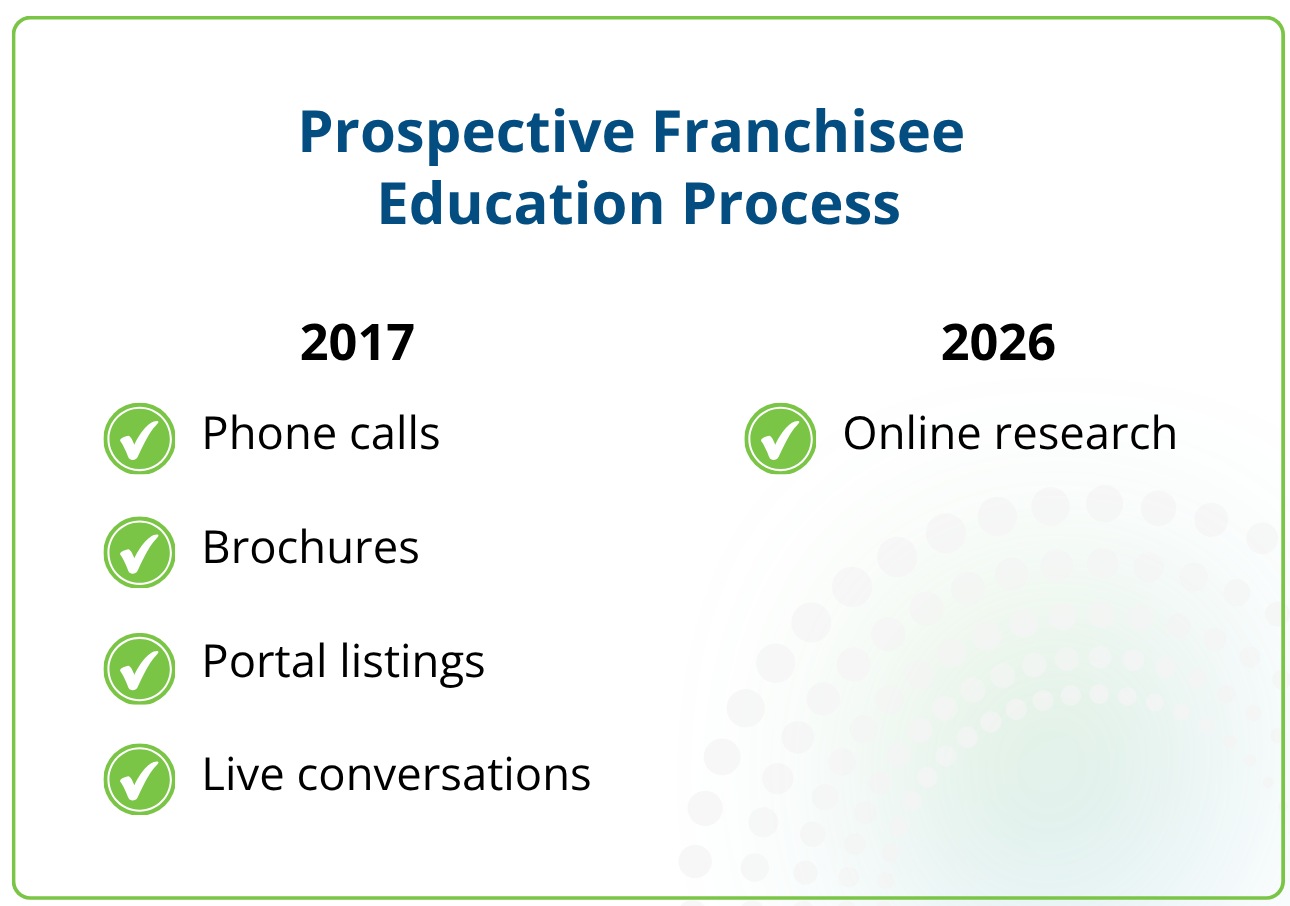
In 2017, the franchise discovery process was already beginning to move online, but it still relied heavily on direct human interaction. Prospective franchisees would often begin by speaking with brokers, franchise consultants, or development reps to understand which concepts might fit their budget, background, and goals. Much of the early education happened through phone calls, brochures, portal listings, and live conversations rather than independent digital research.
At that time, the website often played a limited role. Its main job was to create interest and capture a lead. Once a prospect filled out a form, the sales process took over. The brand could then shape the conversation, answer questions in sequence, and guide the buyer through the opportunity.
This model gave franchisors more control over the buyer journey. It also meant weaker websites could still perform if the brand had strong brokers, experienced development reps, and a solid follow-up process. Buyers expected to learn by talking to people.
The Shift Toward Digital Research
That model has changed significantly. By 2026, the franchise buyer journey is largely self-directed in its early and middle stages. Buyers now expect to research independently, compare brands online, and narrow their choices before speaking with anyone.
Industry sources report that serious franchise buyers visit a franchise opportunity website about 16 times on average, compared with just 3 to 4 visits for casual leads. The same research found that buyers spend about three hours consuming content on these sites, while non-buyers spend only around 20 minutes. That difference is important. It shows that serious candidates are not just browsing. They are studying.
This means the website is no longer just a lead-capture tool. It is now one of the main places where the buyer evaluates, compares, and either advances or eliminates a brand.
A Narrower, More Selective Buyer Journey
Another major change is how narrowly prospects focus their research. Buyers are not exploring dozens of concepts and then calling around for information. Many are beginning with a very short list and engaging only one or two brands.
One industry report stated that 38.2 percent of prospects select only one franchise opportunity for follow-up, while another 17.5 percent select a second concept. In total, nearly 56 percent of prospects inquire about only one or two franchise brands. That is a critical change.
For franchisors, it means many brands are ruled out before a form fill is ever completed. The shortlist is often formed in private. A prospect may research six or seven brands online, choose one or two that feel credible and relevant, and ignore the rest. If your brand does not present the right information clearly and early, you may never get a shot at a conversation.
The Pandemic Accelerated the Change
The COVID-19 pandemic accelerated a trend that was already underway. It pushed more of the franchise development process online and forced brands to adapt quickly. Virtual discovery days became common during that period and have remained a standard part of the process even after in-person options returned.
This change was not temporary. Virtual and hybrid engagement proved efficient for both brands and candidates. Broader virtual event research shows that more than 93 percent of organizers reported success with attendance, and more than 95 percent planned to continue using virtual elements in future events.
In franchising, that shift aligned well with modern buyer preferences. Candidates want flexibility. They want access to information on their own schedule. They want the ability to evaluate before committing time to travel or live meetings.
From Lead Volume to Buyer Quality
Another important shift between 2017 and 2026 is the industry’s understanding of lead quality. For years, many franchisors focused heavily on increasing inquiry volume. More leads were seen as the clearest path to more deals. But the data has long shown that lead count and buyer count are not the same thing.
In fact, industry research shows that of the 1 to 2 million people who request information about franchises annually, only around 13,000 to 20,000 actually become franchise buyers. That is roughly 1 to 2 percent. This has pushed more sophisticated brands to stop asking only “How do we get more leads?” and instead ask “How do we attract and convert more real buyers?”
That distinction matters because real buyers behave differently online. They spend more time. They return repeatedly. They consume more content. They want more proof, more clarity, and more validation before they engage.
Why Content Now Plays a Central Role
As the buyer journey moved online, content became much more important. In 2017, content marketing was growing in importance, but by 2026 it has become central to franchise development. Buyers use content to answer the questions they used to ask brokers and salespeople directly.
Today’s buyers want content that helps them understand:
What the business model is
What the franchisee actually does day to day
What the investment range looks like
What support they will receive
Whether current franchisees are satisfied
Whether the brand feels credible and scalable
They also want content matched to stage. Early in the journey, they need educational material about franchising, ownership models, and fit. Later, they want brand-specific content, validation, testimonials, and financial context.
This is one reason why thin websites underperform. If a site only offers a generic overview and a “Request Info” form, it leaves too many questions unanswered. Serious candidates often move on rather than wait for someone to call them back.
The Problem with Form-First Thinking
Many franchise development systems still rely too heavily on forms as the main trigger for engagement. That was more effective when buyers expected early contact. It is far less effective now.
Today, many qualified prospects will not fill out a form until they are already deep into their research. Some may never fill out a form until they have nearly made a decision. Others may leave your site, continue comparing brands, and never return.
This creates a blind spot for franchise brands. They may be investing in traffic through portals, ads, SEO, or brokers, yet only seeing a small fraction of the real research activity happening on their site. If they only optimize for form fills, they miss the larger opportunity to educate and influence prospects earlier in the process.
What This Means for Franchise Brands in 2026
Today, franchise brands need to think differently about their development marketing. The website can no longer function as a brochure with a contact form attached. It must work as a research hub that supports the modern buyer journey
That means asking better questions, such as:
Is our website answering the questions serious buyers actually have?
Are we providing enough detail to stay on a candidate’s shortlist?
Are we relying too much on a form fill to begin the sales process?
Do we have ways to reach and educate buyers before they identify themselves?
Are we creating content for different buyer personas and stages of research?
Brands that can answer yes to those questions are better positioned to compete. Brands that cannot are likely losing buyers quietly and early.
Why Franchise Ninja Is Built for This New Buyer Journey
This is exactly where Franchise Ninja fits. The new franchise buyer journey requires more than traffic generation. It requires a smarter digital experience built around how modern buyers actually research and decide.
Franchise Ninja helps brands build that experience by turning franchise development websites into content-rich research environments. Rather than relying on a single form and a few generic selling points, brands can create:
Publish detailed educational resources
Stay visible during the long period when buyers are researching independently
That matters more than ever as costs continue to rise. Recent data shows the average cost per franchise lead increased from $155 in 2022 to $251 in 2023 and then to $271 in 2024. When lead costs rise, every visit matters more. Franchise Ninja helps brands make those visits count by improving the quality of the buyer experience before a prospect ever speaks with sales.
The New Reality
The franchise buyer journey of 2026 does not look like it did in 2017. Buyers are more independent. Research happens earlier and more deeply online. Shortlists are narrower. Discovery is more digital. And many decisions are shaped before the first live conversation takes place.
For franchisors, this is both a challenge and an opportunity. The challenge is that weaker digital experiences now cost brands qualified candidates. The opportunity is that brands willing to adapt can earn trust earlier, influence more of the decision journey, and improve conversion quality over time.
The question is no longer whether the franchise buyer journey has changed. It has. The real question is whether your brand is built for how buyers research in 2026. Franchise Ninja is the solution brands need to meet that shift head-on. Meet with a Product Ninja to find out how we can help your brand succeed in today’s more competitive environment.
