
Franchise Buyer Persona Profile: The Professional Services Pivot
This article continues our series examining the 15 franchise buyer personas shaping today's franchise landscape. Each persona reflects a specific type of candidate, shaped by career history, financial position, and the way they arrive at a decision. Franchisors who can tell these groups apart recruit better owners and waste less budget doing it.
In the eleventh edition of this series, we profile the Professional Services Pivot. This persona covers physicians, attorneys, and CPAs. They are among the most financially qualified candidates in any franchisor's pipeline. They are also among the most difficult to convert, because they evaluate your brand the way they evaluate a chart, a contract, or a set of financials.
The Professional Services Pivot Buyer Explained

Licensed professionals have spent a decade or more building income that depends entirely on their own hours. The credential produces the earnings. Stop practicing, and the earnings stop with it.
That structure has cracked in recent years. Ownership pathways inside medicine, law, and accounting have narrowed. Consolidation has moved control to hospital systems, corporate parents, and private equity sponsors. What remains is high compensation with very little equity and even less autonomy.
Franchising answers a specific problem for this group. It offers an asset they can own outright, staff with a manager, and eventually sell on the open market. That last point matters more than most brands realize.
Below we walk through the demographics, motivations, capital position, franchise preferences, decision timeline, and pain points of this persona. We close with the messaging and outreach strategies that actually earn a second conversation with a doctor, lawyer, or accountant.
What Is the Demographic Profile of the Professional Services Pivot?
This persona is older, more credentialed, and better paid than most franchise candidates. Age typically falls between 42 and 58. The average age of a practicing physician in the United States is 51 to 52, and attorneys usually begin exploring outside ventures six to ten years into practice. CPAs often surface after reaching partner.

Education is the defining trait. Every member of this persona holds a doctorate or professional degree, plus active licensure and, in many cases, board certification. That credential shapes their identity, their schedule, and their tolerance for reputational risk.
Compensation is high but varies widely by profession and specialty. Current benchmarks look like this:
Physicians average roughly $386,000, with primary care near $298,000 and specialists near $417,000. Orthopedics, cardiology, and radiology all clear $570,000.
Large firm associate attorneys sit on a scale running $235,000 for first years up to $455,000 for eighth years, following the 2026 market reset.
Equity partners at the largest firms average profits per partner above $3 million, while overall partner compensation averages closer to $1.89 million.
CPA firm equity owners report median compensation around $202,500, with net remaining per owner near $252,700.
Debt is a real factor for the younger end of this persona. Median medical school debt runs $205,000 to $215,000. Median law school debt is roughly $112,500, or $137,500 including undergraduate borrowing.
Households are typically dual income with school-age or college-age children. Geography is dictated by licensure and family, not opportunity, which makes them far less mobile than other personas. Work weeks are long. Physicians average 49 hours. Attorneys averaged 51.7 hours per week in the fourth quarter of 2025, the highest level since early 2021.
What Motivates Physicians, Attorneys, and CPAs to Buy a Franchise?
The persona framework defines the driving needs as diversified income, professional freedom, and reputational prestige. In practice, those needs show up as four distinct motivations.
1. Escape from employed status rather than escape from the profession
As of January 1, 2026, 82 percent of United States physicians are employed by hospitals or corporate entities, up from 25.8 percent in 2012. Corporate entities now own more practices than hospitals do.
Physician burnout has improved to 41.9 percent from a 2021 peak of 62.8 percent, yet 83 percent still report working at or above capacity. On the legal side, satisfaction has fallen to the lowest level recorded since tracking began, with 51 percent of lawyers reporting stress most or all of the time.
2. Building something they can actually sell
This is the most underused argument in franchise development. A law practice cannot be sold to outside capital in 46 of 50 jurisdictions, and it can be sold only to another lawyer.
No state permits non CPA majority ownership of an attest accounting firm, which is why every recent private equity accounting deal relies on an alternative practice structure workaround. A franchise carries no such restriction. It resells to any qualified buyer at a market multiple.
3. Income that does not require their hands
Roughly 39 to 40 percent of physicians already run a side venture, averaging about $34,000 a year for roughly 21 hours a month. Real estate and consulting lead the list. The intent is already there. The scale is not.
4. Tax structure
Under Section 199A, health, law, accounting, and consulting are classified as specified service trades or businesses. The qualified business income deduction phases out entirely for these professionals above the upper threshold.
Most franchise concepts are not specified service businesses, which means franchise profit may qualify for a deduction their practice income cannot claim. Present this as a question for their own CPA, never as a promise.
How Much Capital Does This Persona Have Available?
Estimated net worth for the Professional Services Pivot runs $1 million to $3 million. However, composition matters more than the headline figure.
About 60 percent of physicians have net worth above $1 million, and the share above $5 million has nearly doubled to 19 percent. But physician wealth breaks down as roughly 38 percent retirement accounts and 27 percent real estate, with only 2 percent in business equity. Attorney partners face a similar squeeze, since their firm capital account is illiquid and firm-controlled. Advisors commonly apply a 30 to 50 percent liquidity discount to it.
What that means for qualification criteria is straightforward. Franchise brands typically require liquid capital equal to 20 to 50 percent of total investment, with net worth requirements two to four times the liquid figure. This persona can usually deploy $150,000 to $500,000 in liquid capital without touching retirement accounts, supporting a total investment of $250,000 to $1.2 million.
Their preferred funding routes differ from other personas in ways worth knowing:
Securities-backed lines of credit are the favorite tool, advancing roughly 95 percent against cash and Treasuries and about 70 percent against equities. They borrow without triggering capital gains and without interrupting compounding.
Conventional bank debt is common, since income documentation is never an issue for this group.
SBA lending remains available, though 2025 and 2026 rule changes reinstated the 10 percent equity injection, lowered the small loan threshold to $350,000, and require SBA Franchise Directory listing. Loan caps for 7(a) and 504 rise to $10 million on July 4, 2026.
Retirement account rollover funding is a poor fit here. The IRS itself calls the structure questionable and found that most businesses funded this way failed. A CPA candidate will end the conversation if a broker pitches it casually.
What Kind of Franchises Attract the Professional Services Pivot?
This persona gravitates toward high-margin, credential-adjacent concepts that can be run by a general manager. Prestige is a stated need, so brand quality carries real weight.
The categories that consistently draw physicians, attorneys, and CPAs share strong unit economics and transparent reporting:
Health, wellness, and med spa concepts, which offer clinical adjacency and net margins in the 15 to 30 percent range.
Home services, which post the strongest return on invested capital in franchising. Median unit revenue near $1.4 million on roughly $201,000 of investment, with net margins of 12 to 20 percent.
Senior care, which pairs a demographic tailwind with average unit volumes near $1.3 million on investments of $55,000 to $160,000.
Children's services and behavioral therapy, which combine mission alignment with the fastest category growth in the system.
Business services, a category where every brand discloses financial performance.
The concepts they avoid are equally predictable. High labor and thin margin food service at scale rarely survives their analysis. Neither does any model requiring weekend owner presence, or any brand that declines to publish financial performance data.
One practical note on structure. Brands that publish separate qualification tiers for owner-operator and semi-absentee tracks, each with its own liquid capital, net worth, and hour requirements, qualify this persona far faster than a single generic lead form. There is real precedent in the market, including weight management brands that require $250,000 liquid and $750,000 net worth for the semi-absentee track versus $100,000 and $400,000 for owner-operator.
How Quickly Does the Professional Services Pivot Commit?
The persona benchmark is three to six months, which is faster than the current market average of roughly 24 weeks from lead to signed agreement. The reason is simple. They already have the capital and rarely need a financing contingency.
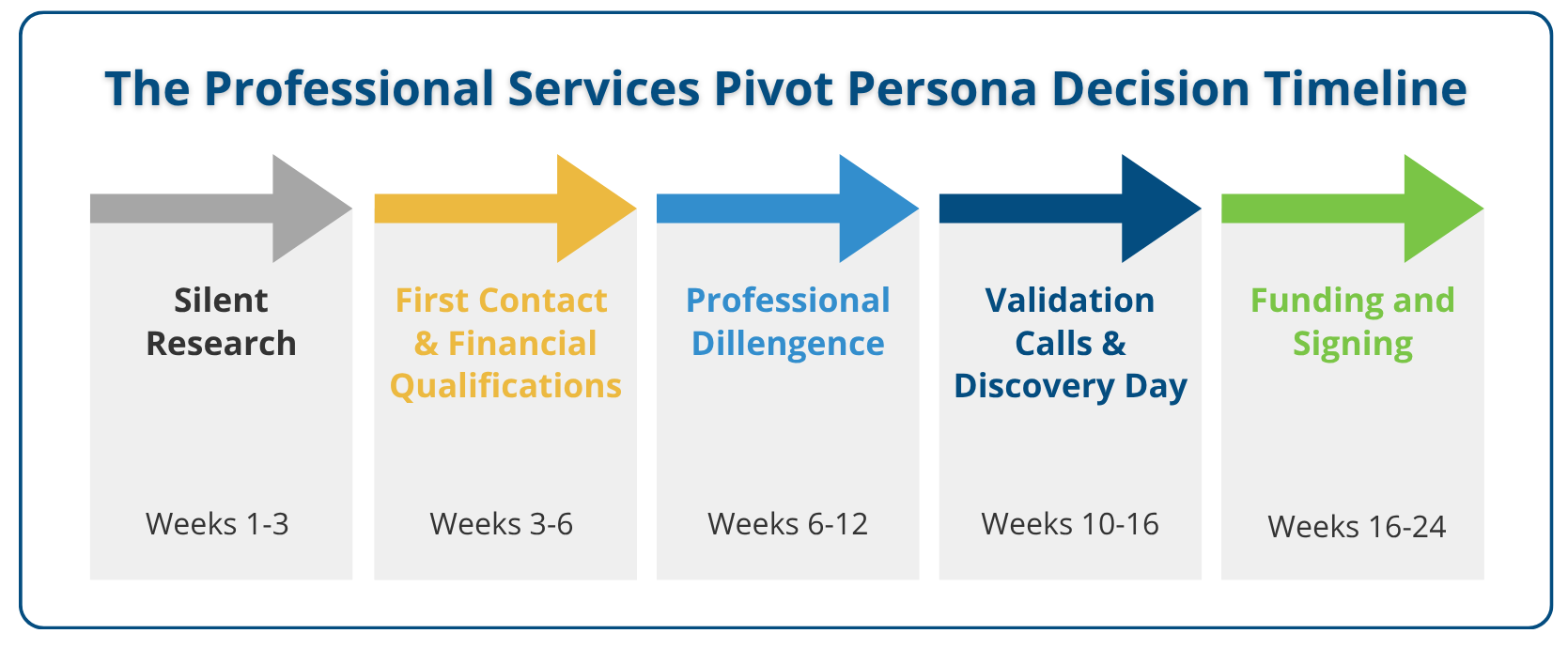
Speed depends almost entirely on how prepared you are for their diligence. The sequence typically runs as follows:
Weeks one through three are silent. They read your disclosure document, run searches, and query AI assistants without ever identifying themselves. Much of the decision forms before you know they exist.
Weeks three through six bring first contact and financial qualification. They arrive informed and immediately test whether your development rep can speak in financial terms.
Weeks six through twelve cover professional diligence, with their own attorney and CPA reviewing the disclosure document. This is the longest and most fragile phase.
Weeks ten through sixteen involve validation calls and discovery day, which almost always require evening scheduling and often a spouse.
Weeks sixteen through twenty-four cover signing and funding.
Getting this persona to discovery day is the entire game. Industry conversion data shows roughly 12 percent of qualified leads convert to a sale, while 75 percent of discovery day attendees do.
What Pain Points and Financial Concerns Hold Them Back?
Despite strong balance sheets, this persona stalls for reasons that are specific and largely unaddressed by most brands.
Opportunity cost is the first barrier.
A physician earning $417,000 values an hour at roughly $200. A partner attorney values it at far more. Every hour spent on diligence, site selection, or manager interviews carries a hard price.
A concept projecting modest year two owner earnings looks like a losing trade unless you frame the return as equity accumulation and tax efficiency rather than income replacement.
Skepticism about earnings claims is the second.
Financial performance representation is voluntary, and roughly 30 percent of franchisors disclose nothing at all. Among brands that do disclose, a thin presentation or one showing only top quartile results reads as concealment to an auditor.
Disclosure is universal in business services, senior care, health and wellness, and staffing. A thin disclosure, or one showing only top quartile results, reads as concealment to an auditor.
Undercapitalization risk is the third.
Estimated initial expenses typically cover zero to three months of working capital, while breakeven commonly takes six to eighteen months. The recommended reserve is two to five times the disclosed figure. Silence on that gap looks like bad faith.
The semi-absentee credibility gap is the fourth.
This is also the most damaging. Semi-absentee ownership is marketed as 10 to 15 hours a week. It generally runs 30 to 40 hours in years one and two. A general manager costs $45,000 to $80,000, and covering that manager plus an owner return usually requires around $600,000 to $700,000 in revenue at a 15 percent margin. Truly absentee ownership works in only 15 to 20 percent of categories. This persona has no spare hours, so an overpromise here ends the relationship permanently. Then they tell colleagues.
Two further barriers deserve attention. Comfort with the asset class is low. Physicians report comfort investing in securities at 33 percent and real estate at 26 percent, but non-medical businesses at just 7 percent. That is a familiarity problem, not a capital problem, and education solves it.
Licensure anxiety is the other. Corporate practice of medicine statutes in roughly 31 to 33 states restrict clinical ownership but do not restrict non-clinical franchise ownership. Attorney conduct rules govern law-related services and business transactions with clients, not ownership of an unrelated operating business. Most brands never clarify this, and the assumption quietly disqualifies good candidates.
How to Market To and Attract the Professional Services Pivot
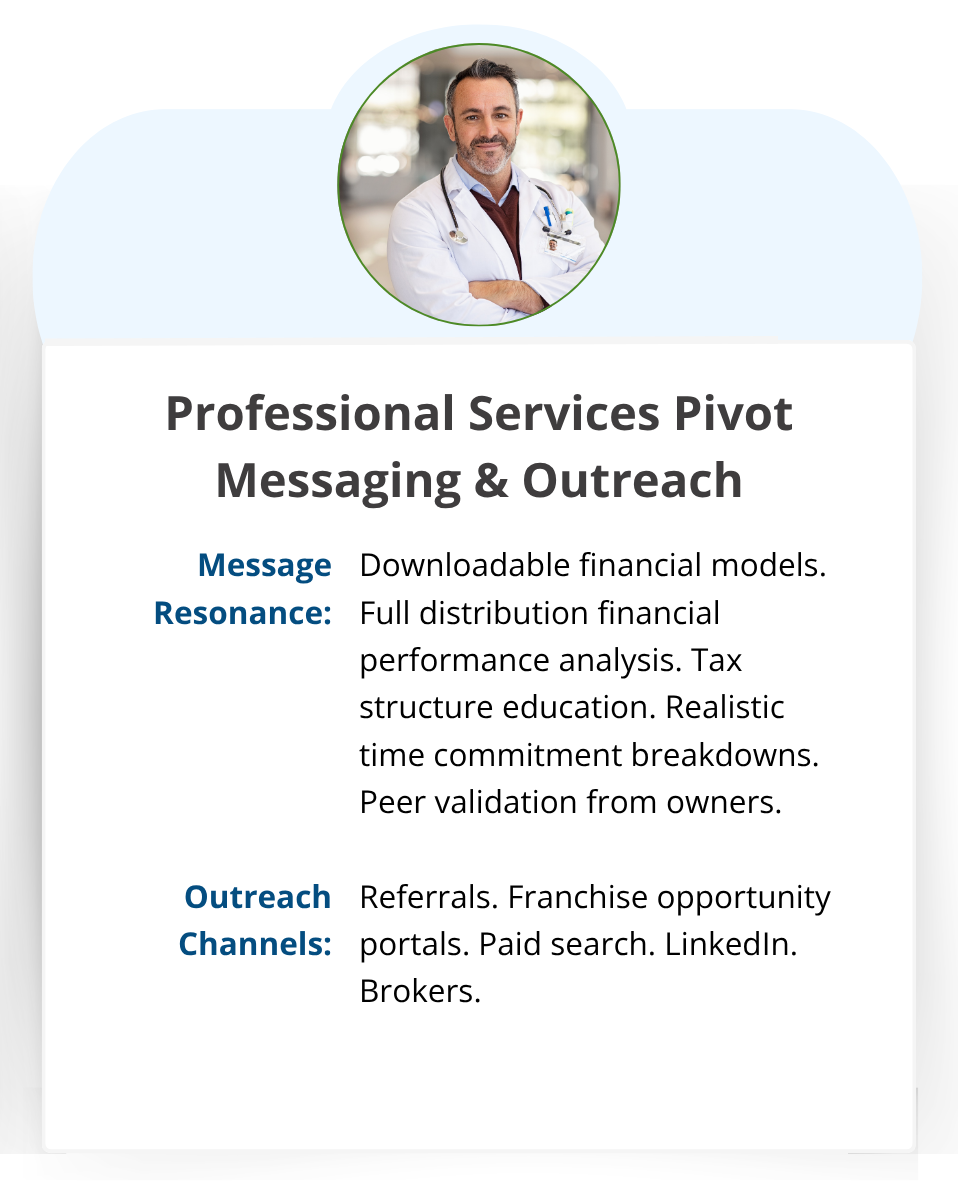
Marketing to this persona requires a different posture than marketing to career changers. Inspiration does not move them. Verifiable numbers do.
Lead with the equity argument rather than the freedom argument. Every brand promises freedom. Almost none point out that a licensed practice cannot be sold to outside capital while a franchise can. That single reframe separates you from the field.
The content formats that earn their attention share one trait, which is that they can be checked:
Downloadable financial models, including pro forma spreadsheets, debt service coverage calculators, and payback period tools. They want inputs they can change, not a rendering of a storefront.
Full distribution financial performance analysis, including bottom quartile results. Showing the weak quartile is the single highest trust move available with this audience.
Tax structure education covering the specified service business exclusion, cost segregation, and entity selection, always framed as questions for their own advisor.
Honest time commitment breakdowns by year. Publishing 30 to 40 hours for year one beats a competitor claiming ten.
Peer validation from owners holding the same credential, with the specialty named.
Language choice matters as much as format. Terms like portfolio diversification, transferable equity, unit economics, leveraged ownership, exit multiple, and protected territory land well. Phrases like passive income, be your own boss, and unlimited earning potential do not. Passive income is the most damaging phrase in your library for this persona. Leveraged ownership is the accurate replacement.
On channel selection, the evidence points in a clear order. Referrals convert at roughly 30 percent while consuming only about 6 percent of typical development budgets, so build referral relationships with franchise specialist CPAs and attorneys, wealth advisors serving physicians, and specialty societies.
Franchise opportunity portals convert near 22 percent. Paid search leads digital channels at roughly 26 percent, with search optimization near 18 percent. LinkedIn use among franchise development teams has climbed past 52 percent, and it remains this persona's native platform with unusually precise credential targeting. Brokers convert roughly one in twenty compared with one in two hundred for cold internet leads, which justifies the cost at this deal size provided the broker is financially fluent.
Three tactical adjustments improve results immediately.
Adapt your response speed rather than just accelerating it, because a physician who submits a form at nine in the evening cannot take a nine in the morning call. Respond within four hours with substance in writing, and offer evening and weekend slots.
Gate less material, since documents that require a phone call to unlock repel a diligence-driven buyer.
Invest in generative engine optimization. Organic click-through rates have fallen sharply under AI-generated search summaries, while brands cited in those summaries earn meaningfully more clicks. This persona asks an AI assistant about your brand long before contacting you.
The solutions that close the gap are concrete:
Publish complete financial performance data with quartiles and ramp curves.
Preload your validation list with owners who have the same credentials and their mobile numbers.
State the working capital requirement above the disclosed estimate and name the runway to break even.
Offer a financing menu rather than a single path.
Introduce a franchise CPA and franchise attorney before they ask, because volunteering scrutiny signals confidence.
Show the multi-unit path on day one, since this persona underwrites the second and third unit while evaluating the first.
Bring third-party owner satisfaction research rather than franchisor-produced testimonials.
Design the process around their calendar, with evening validation calls and weekend discovery day options.
Brands that do this well stop selling a lifestyle and start presenting an investment. That is the only frame this persona trusts.
What's Up Next?
The professional services pivot shows how much of franchise recruitment success depends on matching your evidence to how this buyer thinks and makes decisions. Physicians, attorneys, and CPAs are not skeptical because they doubt franchising. They are skeptical because their training rewards it. Give them complete data, honest hour expectations, and a credible exit story, and they become some of the strongest owners in any system.
Check back next month for the next installment in the Franchise Buyer Persona series. If you haven’t already, read more about the personas we’ve already covered: the Master Franchisee; the Veteran; the Industry Insider; the Home-Based, Low-Cost Lifestyle Seeker; the Immigrant/E-2 Investor; the Semi-Absentee Executive; the Multi-Unit/Multi-Brand Mogul; the ROI-Driven Buyer; and the Corporate Refugee.
