
Franchise Buyer Persona Profile: The Master Franchisee
This article continues our series on the 15 franchise buyer personas shaping today’s franchise landscape. Each persona reflects a distinct segment of candidates defined by their background, investment profile, and decision-making behaviors that franchisors must understand to attract and award the right owners for their system.

In this installment, we take a deep dive into the Master Franchisee / Area Developer buyer. Often positioned as regional developers or territory leaders, these candidates think beyond single-unit ownership and focus on building out markets, supporting sub-franchisees, and driving long-term royalty streams. They are typically seasoned operators or investors with strong management experience, a portfolio mindset, and a disciplined, ROI-driven approach to evaluating opportunities.
Here we will explore the demographic and professional profile of the Master Franchisee, their motivations, pain points, and preferred concept types. We will also look at how they assess investment timelines, what they expect from a franchisor partnership, and which marketing strategies and messages most effectively move them from curiosity to commitment. Finally, we will outline practical steps franchisors can take to reduce friction in the process, mitigate perceived risk, and build confidence with this high-value persona.
What Is the Demographic Profile of the Master Franchisee?
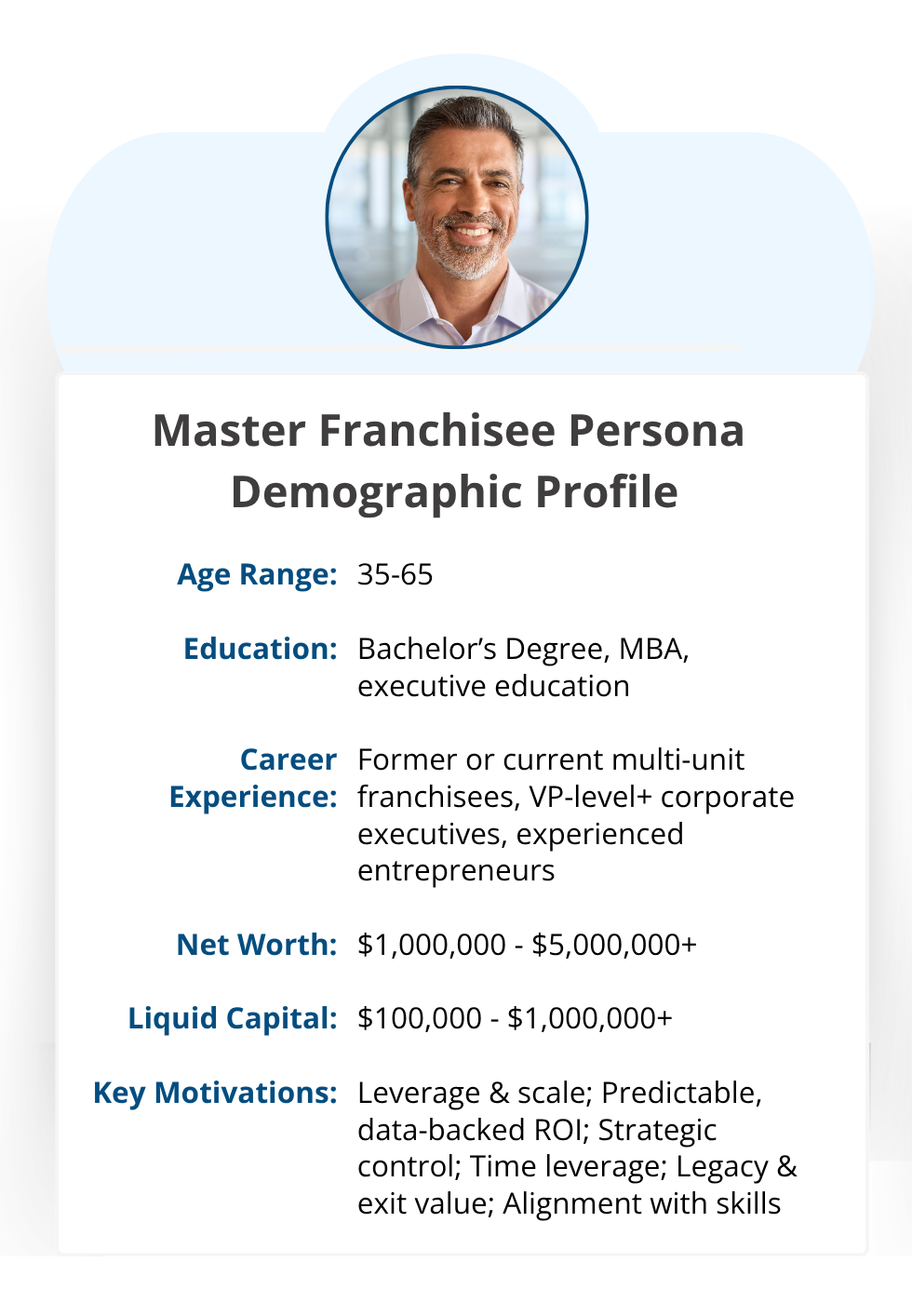
The Master Franchisee buyer persona represents a high-capacity investor-operator who is focused on controlling and developing a defined territory rather than running a single location. This group blends executive-level business experience with the appetite and resources needed to build a regional network of franchisees over time.
In terms of age, master candidates typically fall in the late-30s to mid-60s range, with a notable concentration in Gen X and older Millennials who now dominate franchise buyer pipelines. These individuals have had time to build both capital and career credentials and are now looking for scaled opportunities that match their experience.
Educational backgrounds are usually strong. Most hold at least a bachelor’s degree in disciplines such as business, finance, engineering, or management, and many have advanced degrees or executive education that supports their leadership roles. They are comfortable with financial statements, KPIs, and structured planning.
Professionally, Master Franchisee candidates often come from one of three paths. They commonly include:
Former or current multi-unit franchisees
Area developers or regional operators
Senior corporate executives with P&L responsibility
Their prior roles may span:
Operations and field management
Sales leadership and business development
Regional or national management
Entrepreneurial ownership of one or more businesses
These candidates bring a track record of leading teams, managing budgets, and executing against performance targets over many years.
Financially, the Master Franchisee persona is well-capitalized. Typical net worth falls in the low-to-mid seven-figure range and can extend higher, reflecting the higher capital requirements of territory rights and infrastructure. Personal or accessible liquid capital usually ranges from mid-six figures upward, with some brands requiring at least $100,000 and others several million depending on territory size and development expectations.
Rather than focusing on minimum thresholds alone, this persona zeroes in on total capital at risk. They evaluate territory fees, working capital needs, staffing, marketing, and the operational runway required before the business becomes self-sustaining. They are deliberate in how they structure debt, equity, and reserves to support a multi-year rollout.
Psychographically, these individuals see themselves as builders and leaders more than operators of a single store. They are comfortable with complexity, confident in their ability to recruit and coach franchisees, and motivated by both financial outcomes and the satisfaction of developing a market under a brand they believe in.
Geographically, Master Franchisees typically live in or close to major metros or high-density regions where territory-based rights can be leveraged into meaningful scale. They look for markets with enough population and economic activity to support a pipeline of sub-franchisees and multiple locations.
What Motivates the Master Franchisee to Buy?
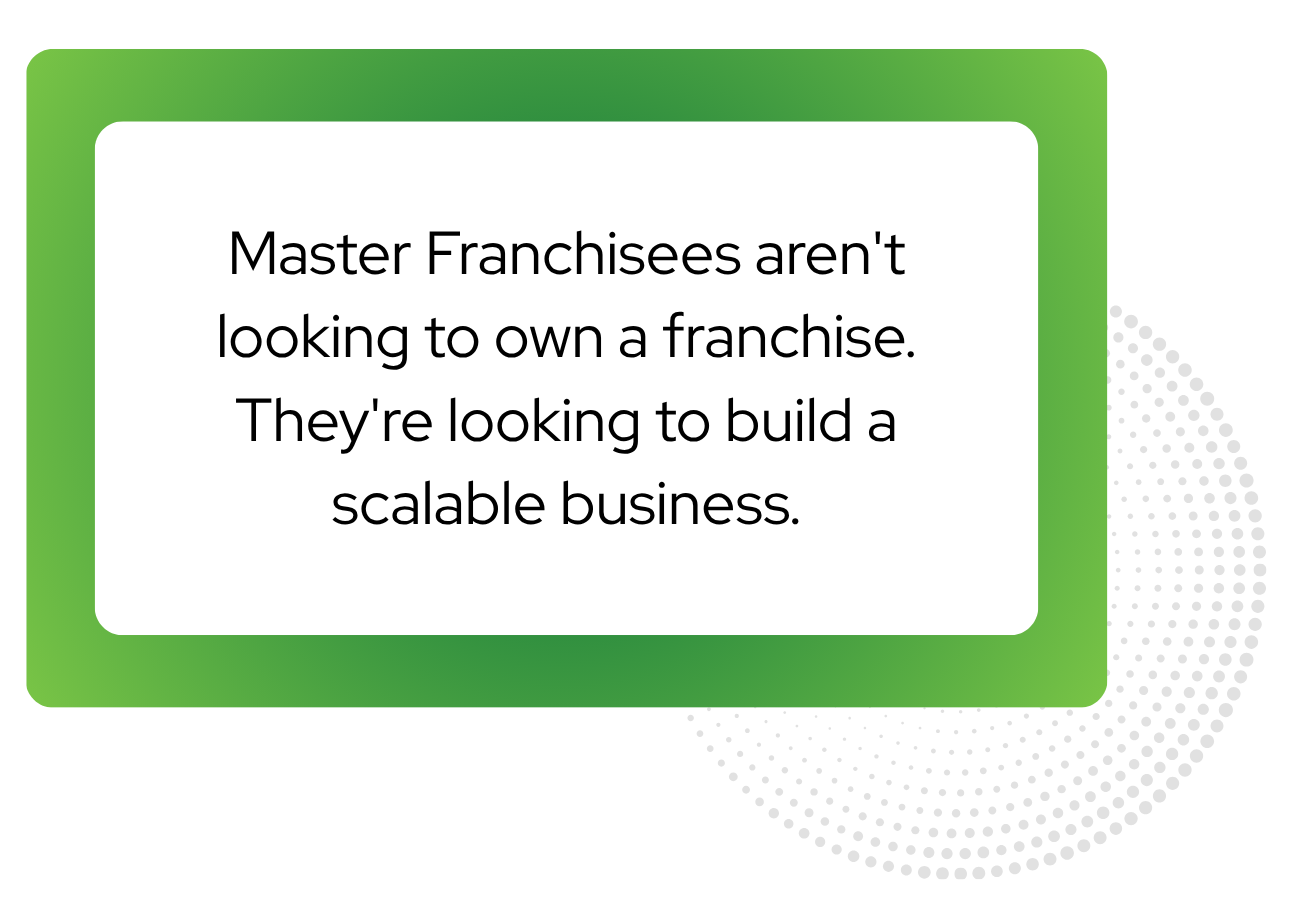
Motivations for the master franchisee are distinct from those of a single-unit owner. They are less focused on replacing a job and more focused on building a regional asset that can grow and appreciate over time.
At the core, this persona is seeking leverage. They want to control a defined territory, award sub-franchise rights, and earn from both initial fees and ongoing royalties generated by a network of franchisees. Rather than running the day-to-day of a single site, they prefer to focus on development, coaching, and performance management across many units.
Several primary motivations tend to shape their interest in master rights:
Scale and portfolio growth
Predictable, data-backed ROI
Time leverage and system building
Strategic control of a region
Long-term exit value
Alignment with existing leadership skills
For these buyers, franchising offers a proven concept, brand, and playbook while still allowing them to build a meaningful enterprise of their own. They see the opportunity to apply their experience in P&L management, sales, and operations within a framework that has already been tested in other markets.
Predictability and visibility into returns are equally important. Master Franchisees want to see strong underlying unit economics, multi-unit performance histories, and realistic development economics for the territory they are evaluating. They are drawn to concepts where the link between effort, execution, and financial performance is clear and where the brand can demonstrate a track record of supporting multi-unit or multi-territory growth.
Finally, legacy and enterprise value matter. Many master candidates are conscious of building an asset that can be sold, passed on, or recapitalized in the future. A well-developed territory with a healthy base of sub-franchisees and stable royalties can represent a compelling exit opportunity.
What Kind of Franchises Draw Master Franchisees?
The master franchisee persona is selective about concepts. They look for business models that can scale across territories and maintain consistent performance at the unit level. In most cases, they prioritize:
Concepts with strong, repeatable unit economics
Models that enable recurring revenue or contract-based income
Simple operating structures that are easy to replicate and teach
Brands with clear differentiation and a defined value proposition
Sectors that often align with these preferences include:
Commercial cleaning and facility services
Maintenance and B2B services
Staffing and workforce solutions
Simple, replicable food or retail concepts that can open multiple locations per market
Master Franchisees value business models where they can focus on sales, development, recruiting, and coaching sub-franchisees rather than managing highly complex operations themselves. They prefer systems that minimize operational friction at the unit level and can be readily adopted by local operators.
At the same time, they tend to avoid concepts that are overly complex, heavily founder-dependent, or difficult to normalize across many locations. Models that require a highly charismatic owner-operator at each unit or that depend on intricate, hard-to-standardize processes are less attractive for a territory scaling strategy.
How Quickly Do Master Franchisees Commit?
The timeline for a master franchise decision is deliberate and structured. It is common for these candidates to take several months to move from initial awareness to a signed agreement. In many cases, the process spans approximately three to nine months. Timing is influenced by:
Capital readiness and access to funds
The number of concepts under consideration
The complexity and size of the territory
The level of partner, spouse, and advisor involvement
The evaluation journey typically follows a series of stages:
Early interest and basic qualification
Detailed financial and territory review
Validation with current franchisees and master franchisees
Legal review of disclosure documents and master agreements
Final decision with input from spouse, advisors, and occasionally business partners
Throughout this process, the Master Franchisee expects a structured, professional experience. They are accustomed to mid-market or corporate deal-making and often look for data rooms, organized presentations, and clear documentation that supports their analysis.
Because more stakeholders are involved, including spouses or partners in over 80 percent of franchise purchases, their timeline must accommodate multiple decision-makers. The more complex and capital-intensive the territory, the more thorough and extended the due diligence phase is likely to be.
What Pain Points Do Master Franchisees Face?
While master rights can be attractive, they come with a distinct set of challenges that can slow decisions or derail interest altogether. Understanding these pain points is critical for franchisors looking to properly position and support this persona.
The first major challenge is role complexity. Master Franchisees effectively become a regional franchisor. They are responsible for both developing the territory and supporting sub-franchisees through training, coaching, and problem-solving. Balancing sales, onboarding, and ongoing field support can stretch time and resources, especially in the early years.
Another major concern is recruiting and retaining capable sub-franchisees. Master candidates worry about finding enough qualified operators to meet development commitments and sustain brand standards across a region. If the concept struggles to attract franchisees or has a weak funnel, the perceived risk climbs quickly.
Territory and market risk also weigh heavily. Candidates are sensitive to questions such as whether the territory has enough capacity, whether boundaries are protected, and how digital or adjacent competition might impact demand. They want confidence that contractual development schedules align with real market potential.
Operational infrastructure is another stress point. Building a regional office, hiring staff, and putting systems in place for sales and support creates overhead before revenue fully materializes. The early years can feel capital-intensive and resource-heavy.
Brand maturity and proof of concept in the relevant market are also key. Master Franchisees hesitate when a brand has limited history, thin performance data, or unproven results in their country or region.
Legal and regulatory considerations can add complexity, especially for international or cross-border agreements where franchise rules, labor laws, and consumer protections differ.
Finally, like other franchise buyers, master candidates must align with their spouse or partner and advisors. Differing risk tolerance, concerns about time commitment, or skepticism about the model can all become obstacles.
What Financial Concerns Shape Their Decisions?
Financial considerations sit at the center of the Master Franchisee’s evaluation process. These candidates are sophisticated, highly analytical, and quick to spot inconsistencies or gaps in a financial story.
The overall capital structure is a core focus. Master opportunities typically require more investment than single-unit deals, with ranges that often start around $100,000 and can reach into the multi-million-dollar level depending on brand and territory. Funds are directed toward:
Territory or master fees
Local office or infrastructure
Staffing for sales and field support
Initial and ongoing marketing
Training and onboarding
Working capital during ramp-up
Several specific financial concerns commonly prevent ROI-focused candidates from moving forward:
Insufficient clarity around margins, profit ranges, and required working capital
Vague or overly optimistic earnings representations
Underestimated marketing and operating costs
Weak or inconsistent unit-level performance data
Aggressive development schedules not aligned with market demand
Concerns about illiquidity and downside risk if the brand underperforms
This persona needs precise numbers and realistic projections. They expect to see how the economics play out across different ramp speeds and unit counts, not just best-case scenarios. If the financial narrative does not stand up to scrutiny, they will disengage.
How to Market To and Attract the Master Franchisee
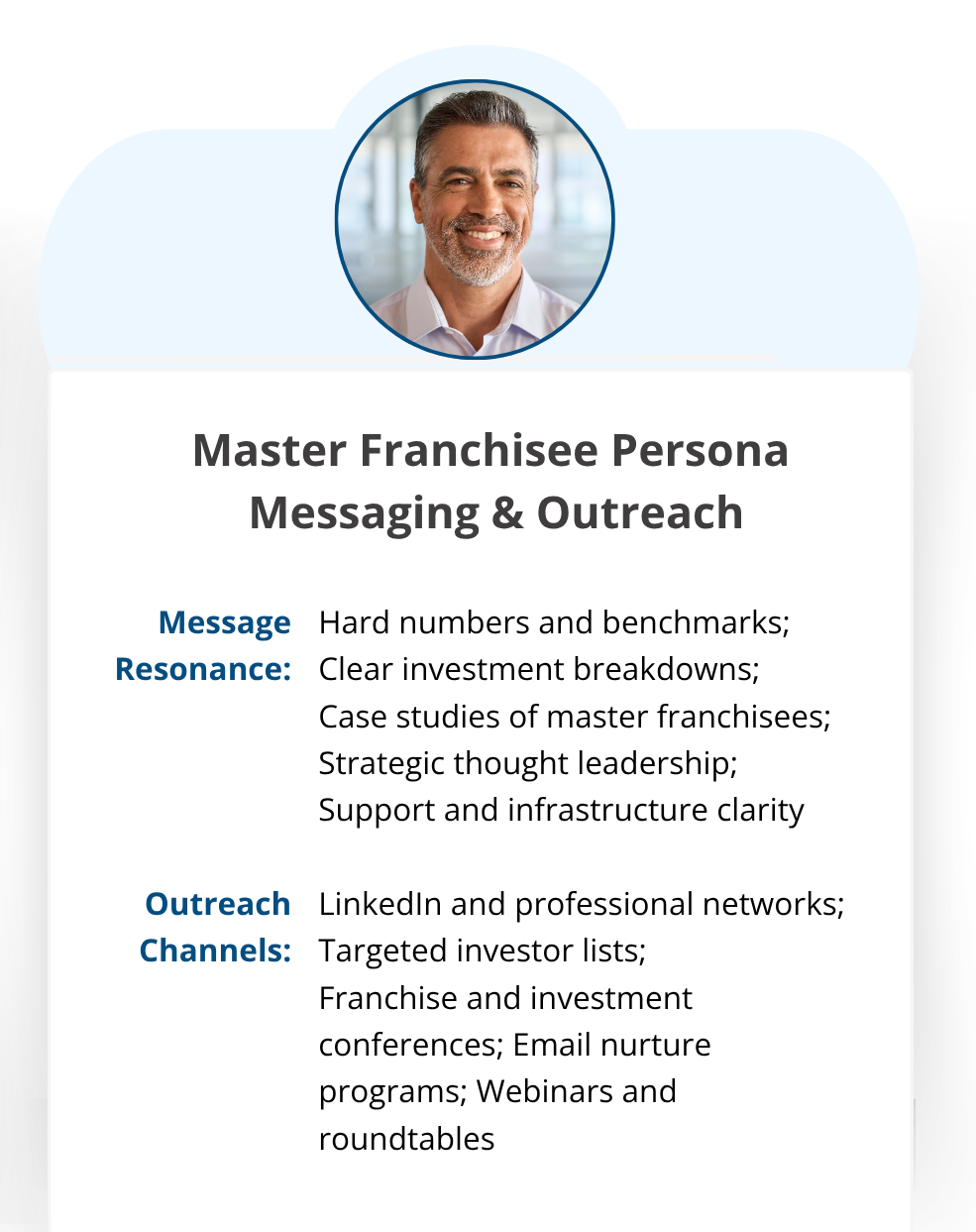
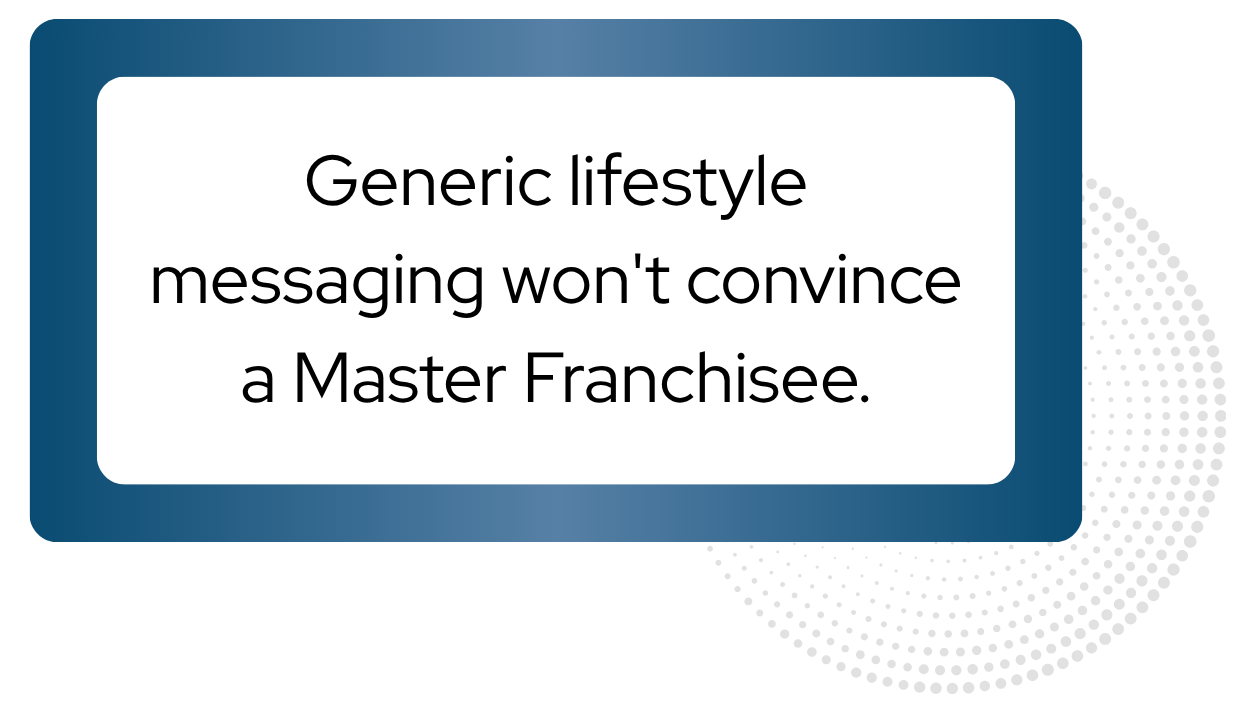
Effective marketing to the Master Franchisee persona requires a clear understanding of their sophistication level, priorities, and expectations. Generic promises and high-level lifestyle claims will not be enough.
Content that performs best includes data-driven, detailed materials that show how the opportunity works in practice. This can include:
Multi-unit P&L examples, where permitted
Territory maps and build-out scenarios
Breakdown of capital requirements and cash flow timelines
Case studies from existing master or regional franchisees
Educational resources that explore topics like territory development planning, franchisee recruitment, and field support best practices signal that your brand understands the realities of master-level growth. Webinars, guides, and playbooks that speak directly to these issues position your team as a strategic partner, not just a seller of rights.
Messaging should emphasize:
Partnership and alignment of interests across the long term
Transparency around both upside potential and risk
The strength of your support infrastructure and tools
A clear roadmap for how a new Master Franchisee will be trained and supported in building their region
From a channel perspective, the Master Franchisee is best reached through professional and investor-focused environments. High-impact tactics include:
Targeted LinkedIn advertising and content aimed at individuals with P&L and multi-unit experience
Outreach to existing multi-unit franchisees and business owners via curated investor lists
Presence at franchise and investment conferences with invitation-only master sessions
Segmented email nurture programs designed specifically for multi-unit and master-level candidates
Webinars and small-group roundtables featuring current master operators
In every interaction, it is important to respect their time. Strong up-front qualification for capital, experience, and growth goals ensures that conversations are relevant and productive. They will respond best to consultative, one-on-one discussions with individuals who can speak in depth about financials, structure, and strategy.
How to Overcome Master Franchisee Doubts and Hesitations
Converting a qualified Master Franchisee prospect requires more than interest. It requires consistent, evidence-based reassurance across financial, operational, and strategic dimensions. On the financial side, franchisors can support this persona by:
Providing clear, compliant earnings information and realistic pro formas
Breaking down all components of investment, including working capital, staffing, and initial marketing
Offering tools that allow candidates to test assumptions and model different growth curves
Operationally, franchisors should showcase their support infrastructure in detail. This includes training programs, field support cadence, technology platforms, marketing resources, and the systems in place to help both masters and sub-franchisees succeed. Demonstrating how the franchisor works with existing territories adds credibility.
Strategically, it helps to collaborate with candidates on a territory development roadmap. This allows both parties to align expectations on unit counts, timing, and resourcing based on real market potential rather than a one-size-fits-all schedule.
Validation is another key lever. Facilitated conversations with successful master or regional franchisees give prospects direct visibility into what the role entails and what results others have achieved.
Finally, a transparent, pressure-free sales process builds trust. Master Franchisees appreciate candid answers to hard questions, openness about challenges, and access to tools that help them independently assess fit and risk. Brands that lean into education, numbers, and partnership are best positioned to win this buyer’s confidence.
What’s Up Next?
This article has explored the Master Franchisee persona as a critical driver of regional growth within modern franchise systems. Understanding their demographic profile, motivations, financial expectations, and decision dynamics helps franchisors and marketers design more effective development strategies, qualification processes, and support frameworks.
As this series continues, we will further map out the spectrum of franchise buyer personas that together shape today’s franchise landscape. Upcoming profiles will examine additional growth-oriented buyer types and provide more tactical insight on how to align the right candidates with the right models for sustainable, scalable expansion.
If you haven’t already, check out information on the franchise buyer personas we’ve covered in this series.
